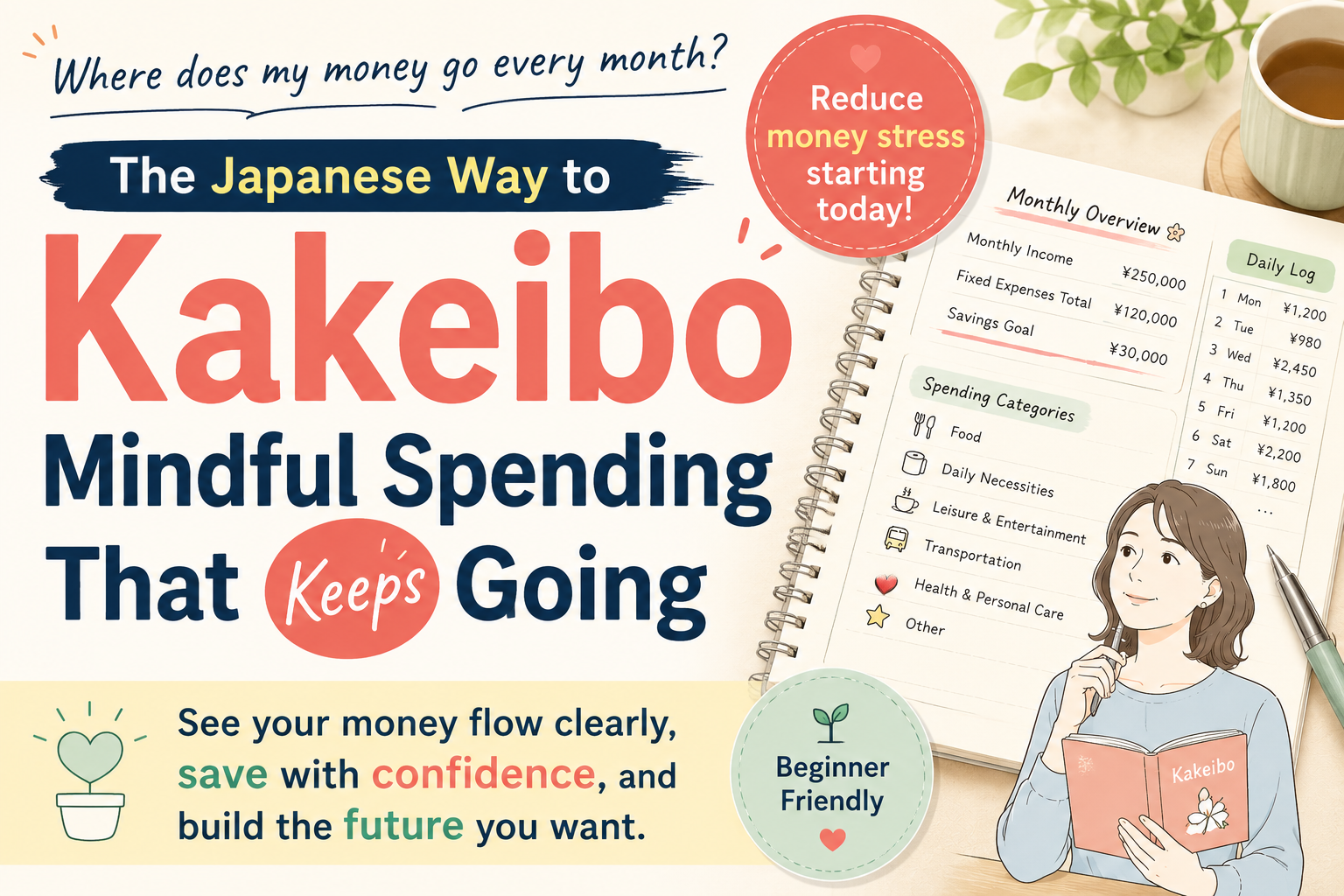
Because a household budget is something you use every day, writing it in English can significantly change the way you study the language. Household management and English learning may seem unrelated, but combining them creates a practical routine that is easier to sustain.
Everyday vocabulary is often difficult to retain from a textbook alone. When you repeatedly see and write the same words in your own household budget, however, they become familiar naturally.
Practical terms such as food expenses, transportation, and insurance premiums appear in textbooks but are not always practiced in real life. Keeping a household budget in English provides that practice.
Without demanding perfection, you can improve English and household-management skills at the same time. This article explains how.
- Three Reasons Keeping a Household Budget in English Improves Your English
- Four Common Vocabulary Categories for an English Household Budget
- Ways to Keep the Practice Effective
- The Benefits Go Beyond Saving Money
- Practical English Expressions for Household Management
- Start an English Household Budget Today
Three Reasons Keeping a Household Budget in English Improves Your English
Language learning is easier to continue when it becomes part of daily life. A household budget is an ideal learning tool because it is already a recurring activity.
First, practical vocabulary is learned efficiently. Terms such as groceries, dining out, and communication costs appear regularly. They are difficult to master through reading alone but become familiar through repeated use.
Second, daily contact with English forms naturally. Instead of creating a separate study period, you add English to an existing household routine.
Third, writing notes and comments in English improves sentence-building ability. Comments such as “Food expenses were higher than last month” or “I will reduce transportation costs next month” provide useful writing practice. One short sentence is enough at first.
Real categories such as dining out, miscellaneous expenses, and insurance premiums are learned in context. “Insurance premium” is no longer an isolated translation when you enter it every month. Repeated use turns knowledge into practical understanding.
Four Common Vocabulary Categories for an English Household Budget
The first category is food and dining. 食料品 can be written as “groceries” or “food expenses.” 外食費 can be “dining out” or “restaurant expenses.” Café spending can be “café expenses,” while drinks may be recorded as “beverages.”
Because food is a major household expense, using phrases with actual figures, such as “Dining out: $150 this month,” creates practical language practice.
The second category is household supplies. Common examples include “toilet paper,” “laundry detergent,” and “shampoo.” The broad label “household supplies” is convenient, but writing individual items can expand vocabulary.
The third category is transportation and communications. 電車代 can be “train fare” or “public transportation,” ガソリン代 can be “gas expenses,” and 携帯電話料金 can be “cell phone bill” or “mobile phone bill.” “Utility bills” is a useful collective term for electricity, water, and gas.
The fourth category is insurance and medical costs. 保険料 is “insurance premium,” 医療費 is “medical expenses,” and 診察料 is “doctor’s fee.” These are important household categories and become easier to remember through monthly use.
By using these categories consistently, you may acquire more than 50 practical words in the first three months. Vocabulary used repeatedly in your own life is retained more deeply than vocabulary memorized in isolation.
Ways to Keep the Practice Effective
The priority is to continue without excessive effort.
First, adjust the level of detail. Trying to record every small purchase creates unnecessary work.
You might decide to record only expenses of 500 yen or more. This reduces entry time and leaves more time for checking English expressions or writing comments.
Continuity matters more than completeness.
Second, limit the number of categories. Ten or more detailed categories create repeated uncertainty. Five or six broad categories such as food, transportation, household supplies, medical expenses, and other are easier to use and label in English.
Third, keep descriptions short. Writing “Dinner at Italian restaurant with friend” every time takes too long.
A compact entry such as “Dinner / Italian / 2,800 yen” is more practical and still provides useful English practice.
Prepare a template of frequent labels such as “Groceries,” “Utility bill,” and “Restaurant.” Reusing them reduces daily effort and gives you more capacity to learn new words.
The Benefits Go Beyond Saving Money
The obvious advantage is that English study and household management happen together, but additional benefits also emerge.
You encounter practical vocabulary every day and build a habit of writing short English sentences. Unlike a textbook with an end date, the practice can continue as long as you keep household accounts.
Writing spending in English may also make it feel more explicit. Seeing “Dining out” repeatedly can increase awareness of how much restaurant spending affects the budget.
English can also support clearer planning. A note such as “Book purchase budget = 3,000 yen” creates a measurable target. Some people find that expressing goals this way makes their monthly planning more deliberate.
Turning spending into English labels can make analysis feel more objective and logical. Over time, this may also support business English, especially when working with numbers, budgets, and statistics.
Practical English Expressions for Household Management
“Keep track of household accounts” is a basic expression for maintaining a household budget.
You can write, “I keep track of my household accounts in English.” A shorter alternative is “Track monthly expenses.”
“Manage household expenses” emphasizes active management rather than simple recording.
Useful variations include “Manage expenses by category” and “Reduce unnecessary expenses.”
“Record payment” is useful for online banking or card transactions, as in “Record payment for utility bill.”
For brief monthly comments, try “Spent more on groceries than expected this month.”
A future goal might be “Will reduce dining out next month.” Repeating phrases in real situations turns them into usable language.
Start an English Household Budget Today
You can begin with a paper notebook or a smartphone memo app. The important point is regular use.
During the first week, keep your normal Japanese budget and replace only the category labels with English, such as “食費 → Food expenses” and “交通費 → Transportation.”
Over one to three months, frequently used terms become familiar and simple sentences become easier to form.
By the third month, you may be able to write a sentence such as “Spent 5,000 yen on utilities this month” without consulting a dictionary. That visible progress supports motivation.
Remove perfection from the process. Spelling and grammar mistakes are acceptable. One minute of simple English every day is more valuable than a perfect English household budget completed once a month.
Once a week, summarize spending in one sentence, such as “This week I spent most on food.” This verbalizes your behavior and strengthens memory.
A household budget can be an excellent English-learning resource because every sentence relates directly to your own life. That personal relevance and repeated practical use make language easier to acquire.
Try combining money management and English study from today.
Small daily entries can gradually develop into substantial language ability.
コメント