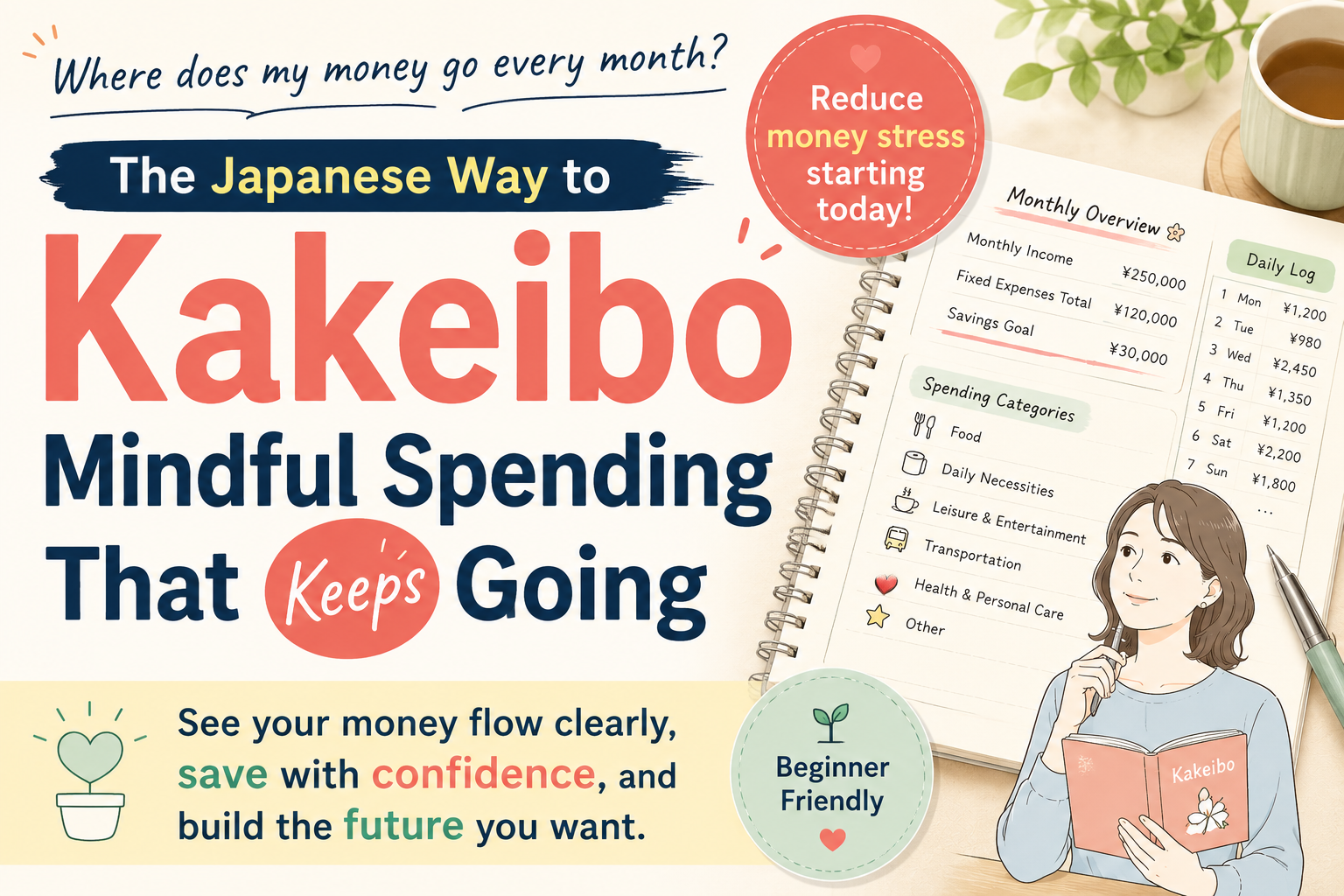
When people decide to start managing household finances, many first turn to an app or software. However, complicated controls and anxiety about whether they can continue often become obstacles.
A simple and reliable alternative is a handwritten household budget. This article explains practical methods for beginners, from taking the first step to creating a daily entry routine and making the practice a habit.
Let us explore handwritten budgeting at your own pace, with the goals of making household finances visible and building savings.
- Three Reasons a Handwritten Household Budget Is Suitable for Beginners
- The First Step: How to Choose a Household Budget Notebook That Suits You
- Four Steps for Entering Information in a Household Budget
- Improve Household Management Through Better Budgets and Goals
- Five Tips for Continuing a Household Budget
- Common Pitfalls for Beginners and How to Handle Them
- Create an Environment That Makes Budgeting a Habit
Three Reasons a Handwritten Household Budget Is Suitable for Beginners
Apps and computer software are increasingly common, but handwritten budgeting has distinct advantages for people managing household finances for the first time.
High Freedom of Customization
A handwritten budget can be adjusted freely to match your lifestyle. Apps and software usually require you to follow preset categories that may not fit your spending patterns.
With handwriting, you can add or remove categories and change their order as you wish. This flexibility creates an environment that beginners can maintain without excessive strain.
No Barrier from Digital Tools
Another advantage is that no machine operation is required. Many people are uncomfortable using smartphones or computers.
With a pen and notebook, you can begin immediately and focus on household finances without struggling with technology. Some people who felt uneasy about computer operation have found handwritten budgeting easier and more enjoyable.
Writing by Hand Increases Financial Awareness
Writing each expense requires you to look at the category and physically record the amount.
This action naturally increases awareness of how money is being used. Unlike automatic app calculations, handwriting makes each expense more memorable.
As a result, wasteful spending is easier to notice, which can lead to greater savings.
The First Step: How to Choose a Household Budget Notebook That Suits You
The first decision when starting a handwritten budget is the notebook itself. From the standpoint of continuity, this is one of the most important choices.
A simple layout is easier to maintain
Simplicity is the most important standard. A notebook with many elaborate sections may look comprehensive.
In practice, however, too many fields create work and eventually feel burdensome. Beginners should choose a simple design that allows necessary information to be entered efficiently.
Space for the date, category, amount, and a simple calculation is usually enough.
Use a diary or memo section
Numbers alone can make household accounting feel like a chore.
A small space for comments, discoveries, and ideas about spending turns the notebook into a tool for reflection. When you review it later, you can understand why spending increased or which saving idea worked, making improvements easier the following month.
Prioritize flexibility in category settings
Some notebooks contain detailed preset categories, while others let you define them yourself.
Beginners should choose a format that allows categories to match their lifestyle. Greater freedom reduces management complexity and lets the record reflect actual household conditions.
A design you like helps maintain motivation
Because you will open the notebook frequently, a pleasing color, cover, and design can matter. A notebook you enjoy looking at is more likely to be picked up regularly. Many people report that choosing a favorite design made household budgeting more enjoyable.
Ready-made versus handmade
You can buy a commercial household budget notebook or create your own format using graph paper or a blank notebook. A handmade version takes more time to prepare, but it can be tailored precisely to your household and may suit people with strong preferences.
Four Steps for Entering Information in a Household Budget
Understanding daily entry as a clear, repeatable process helps beginners continue without confusion.
Step 1: Record the day’s expenses by category
Classify each purchase, such as food, transportation, or clothing, and write down the amount.
Beginners often hesitate when a single purchase seems to belong to more than one category. For example, a supermarket receipt may include both groceries and household goods.
Create a simple personal rule, such as assigning the purchase to the category with the larger amount or to the category that best reflects the main purpose. A fixed rule reduces repeated decision-making.
Step 2: Calculate a daily subtotal
After recording the day’s expenses, total them.
This makes the amount spent that day clear and helps reveal missing entries or calculation mistakes early.
A five-minute routine at the end of each day is enough to begin forming a habit.
Step 3: Total expenses by week
At the weekend, calculate the weekly total for each category.
This reveals patterns, such as weeks with high restaurant spending or weeks when food costs were controlled.
Recognizing such patterns leads to concrete adjustments for the following week and turns recording into practical financial management.
Step 4: Close the month
At the end of the month, total all expenses and compare the result with the budget. Check whether spending exceeded the plan or whether you saved more than expected.
The monthly close is also a time for reflection. Record what worked and what did not, together with possible improvements. This increases the accuracy of household management in the following month.
Improve Household Management Through Better Budgets and Goals
A household budget becomes truly useful when it moves beyond recording and supports planned financial decisions. Budget and goal setting are central to that shift.
Basic budgeting and the distinction between fixed and variable expenses
Use the average of the previous three months as a reference and set a realistic target that includes a modest improvement. For example, aim to reduce food spending by 10 percent from the previous month. Separate fixed expenses, such as rent and utilities, from variable expenses, such as food and transportation, to create a more accurate plan.
Check the remaining budget each week
If the monthly food budget is 30,000 yen, use 7,500 yen per week as a rough guide. At each weekend, check whether spending is on pace. Early awareness makes it possible to adjust before the end of the month.
Set specific and measurable goals
“I want to save more” is vague. Goals such as “save 100,000 yen in three months” or “increase monthly savings by 10,000 yen” are easier to measure and maintain. Writing the goal in the budget creates a daily reminder and can act as a psychological brake on unnecessary spending.
Use a cycle from the beginning to the end of the month
Set the budget and goal at the beginning of the month, check progress every week, and review the outcome at the end.
Strengthen what worked and revise what did not before the next month begins. Repeating this cycle steadily improves the quality of household management.
Many people who continue this process report that the flow of their finances becomes clearer within about three months.
Five Tips for Continuing a Household Budget
Many people understand the value of budgeting but still stop after only a few days. The following practical techniques reduce that risk.
1. Choose tools that support motivation
Because you will handle the notebook every day, selecting a design, color, paper quality, and pen you enjoy is not wasteful. These details can support continuity.
A comfortable pen with attractive ink can turn daily entry from a burden into a small pleasure.
Many people find budgeting more enjoyable after choosing stationery they genuinely like.
2. Manage receipts carefully
Receipts are the main source of information. Losing them makes amounts and categories uncertain and reduces accuracy.
Create a simple system, such as keeping receipts in divided pockets. Review them before bed and enter the day’s purchases.
This routine compensates for forgetfulness and makes records more reliable.
3. Allow rough entries
Beginners often demand too much precision, repeatedly checking calculations or spending time making handwriting neat. That perfectionism can make continuation difficult.
The most important quality is continuity, not perfect appearance. Accept small discrepancies and untidy writing, and prioritize making the entry.
4. Do not aim for perfection
Overly detailed category systems often cause people to stop.
A good household budget is not one recorded perfectly but one that continues. A difficult month is not failure. It is information that can be used to improve the next month.
5. Fix the time for making entries
Choose a regular time, such as 9 p.m. every day or Sunday morning for weekly totals. A fixed schedule turns household accounting into part of ordinary life.
A Hybrid of Handwriting and an App Can Also Work
You can use an app while outside to record purchases and then copy them into the handwritten budget at home. This combines the awareness created by handwriting with the convenience of a smartphone.
Common Pitfalls for Beginners and How to Handle Them
Knowing likely difficulties in advance makes them less likely to cause abandonment.
Handling forgotten entries
Missing a receipt or forgetting a small cash purchase is common.
Rather than demanding total accuracy, enter what you can remember. A short weekly review of possible missing purchases can prevent major omissions.
Complexity in classifying expenses
It can be difficult to decide whether an item belongs to clothing, household goods, or another category.
Write down brief definitions for your categories in advance. For example, decide that all clothing, including underwear, belongs to clothing expenses. Consistent rules speed up entry.
Dealing with differences between the plan and the result
At month-end, spending may be far above the budget or savings may be unexpectedly high. Instead of becoming discouraged, examine why.
Transportation naturally rises in a month with more outings, and food costs may rise when guests visit.
Recognize outside factors first, then consider whether any portion can still be reduced.
Adjusting an entry frequency that is too demanding
Some beginners feel pressured to write every day even when their schedule makes that unrealistic.
Reducing the frequency to three times a week may be more sustainable. Continuity matters more than completeness.
Create an Environment That Makes Budgeting a Habit
Physical and psychological surroundings matter. Keep the notebook in a fixed, visible place so it is harder to forget. Displaying several months of results can also create motivation to continue.
Sharing the budget with family can be effective. Once a month, review it with a spouse or children and discuss household finances. This turns the practice into a family effort and strengthens awareness of saving.
These environmental and behavioral measures are a major reason handwritten budgeting can continue. Apps are convenient, but they do not always create the same feeling that you are personally managing the household. Writing numbers by hand forces regular engagement with financial reality.
Starting a handwritten household budget is not merely expense tracking. It is a process of examining how your household uses money. By applying the notebook selection, entry steps, and habit-building methods described here, beginners can continue without unreasonable effort.
The most important principle is continuity rather than perfection. A few minutes of attention each day gradually reveals the full picture of household finances and supports concrete savings goals.
Begin with a simple notebook and take the first step today.

コメント