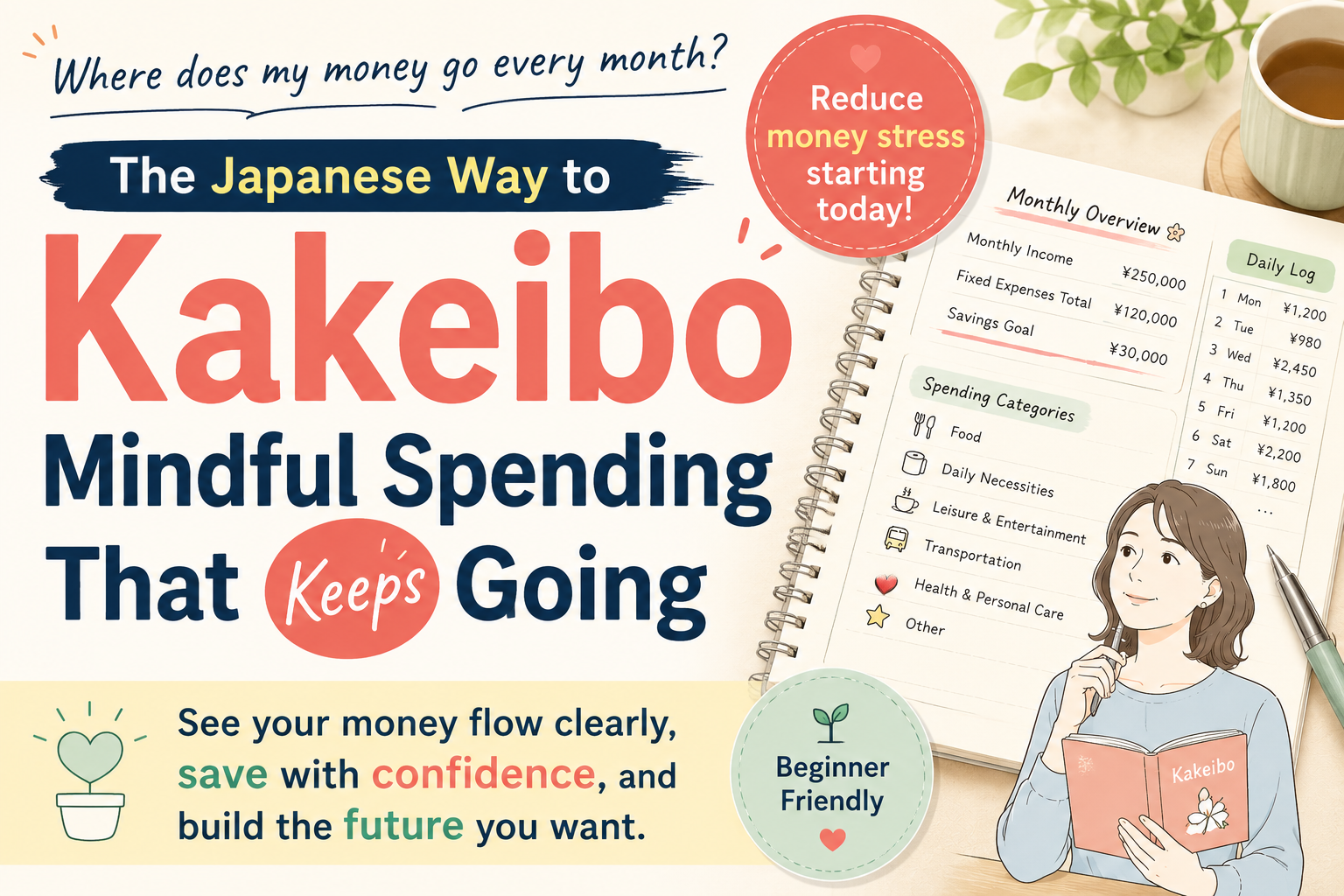
Have you ever wanted to start keeping a household budget? Even though smartphone apps have become the standard, more people are choosing to manage their finances by hand.
The reason is that the physical act of writing can fundamentally change the way you relate to money. This article explains the real value of a handwritten household budget and how beginners can start without strain.
By finding an approach that suits you, household management can gradually become part of everyday life.
- Why a Handwritten Household Budget Raises Financial Awareness
- Three Reasons to Choose a Handwritten Household Budget
- Comparing the Best Ways for Beginners to Create a Household Budget
- Four Handwritten Ideas You Can Start Immediately
- Tips for Setting Categories That Make the Budget Easier to Continue
- Use Template Websites to Prepare Efficiently
Why a Handwritten Household Budget Raises Financial Awareness
The greatest strength of a handwritten budget is that the sequence of handling receipts, using a calculator, and writing with a pen changes your awareness of money. It creates a psychological effect that differs from entering data into an app.
This sense of spending is especially important in an age of cashless payment. Credit cards and smartphone payments create a delay before money leaves the account, which can weaken the feeling that money has been spent. Reviewing a receipt for a handwritten budget makes the expense feel immediate again.
Using a calculator also matters. The act of calculating helps the total remain in memory. People often remember not only the amount but also the time they spent working it out.
Writing each figure also creates a clear sense that you are actively managing the household. That awareness can trigger an unconscious desire to reduce wasteful spending. The principle resembles active learning: people are more likely to change behavior when they engage directly rather than receive information passively.
Three Reasons to Choose a Handwritten Household Budget
Handwriting offers three major advantages over digital tools: lower risk of data loss, greater freedom of customization, and a lower technical barrier.
First, it avoids the risk of losing data when a service ends. If a smartphone app is discontinued, years of records may become inaccessible. Several household-budget apps have ended their services in the past. A paper notebook, by contrast, remains available as long as the physical book exists. It is not affected by device failure or system problems and can preserve records for many years.
If you want to retain ten or twenty years of household-finance history, handwriting is a practical choice.
Second, it offers far greater freedom of customization. Apps limit users to preset categories, while handwriting lets you create categories that match your life exactly. A family with a baby can add diapers and formula, while someone with an expensive hobby can divide that spending into detailed subcategories. This freedom can make the budget easier to continue.
The layout can also be changed in many ways. You can organize by month, by week, or focus on specific types of spending. That level of flexibility is difficult to obtain in an app.
Third, it is easy for people who are uncomfortable with digital devices. Not everyone is confident using a smartphone or tablet. A pen and notebook are enough to begin today, allowing motivation to turn into action without a technical obstacle.
Comparing the Best Ways for Beginners to Create a Household Budget
When starting a handwritten budget, the first question is what to write in. You can buy a commercial product, create one from a blank notebook, or use a printable template. Each method has different characteristics.
The main advantage of a commercial household budget is that the categories and layout are already prepared. You can begin on the day of purchase, and beginners are less likely to feel confused.
Products range from inexpensive books costing around 1,000 yen to more elaborate versions costing several thousand yen. The drawback is that preset categories may not perfectly match your spending pattern.
Creating a budget from a blank notebook gives you complete control over categories and layout.
This makes it possible to build a system optimized for your household. However, designing the initial layout takes time, and poorly balanced entry areas can be inconvenient.
This method is not ideal for people who do not want to spend time designing the budget itself.
Printable templates combine the advantages of the other two approaches. A free template reduces preparation time while allowing some customization. You can also enjoy selecting a design you like. The limitation is that the basic format is still determined by the template.
Four Handwritten Ideas You Can Start Immediately
If you are unsure which method suits you, try one of the following four ideas.
The first is to use a blank or grid notebook. This offers the greatest freedom because you can decide the categories and the size of each section. The disadvantage is the time required to design the layout at the beginning.
The second is to combine household accounting with a planner. Use blank pages in a planner to record expenses. Managing appointments and spending in the same book makes review easier, and existing planner users do not need to buy another notebook.
The third is to write expenses directly into a schedule book. Record each day’s spending in the corresponding date box. This is sufficient for people whose immediate goal is simply to understand spending without detailed classification. A new planner each year can also create a useful sense of renewal.
The fourth is to print a template from the internet each month. This requires very little preparation and suits beginners who care more about continuing than about designing a format. Trying different designs can also prevent boredom.
Tips for Setting Categories That Make the Budget Easier to Continue
Category design has a major effect on whether a handwritten budget continues or is abandoned.
Spending patterns vary widely. A person living alone and a family household naturally have different expenses, and even families differ according to the number and age of children. Standard categories should therefore be adjusted to actual life.
The key is to balance detail with practicality. Categories that are too fine create extra work and make continuation harder.
At the beginning, broad categories such as food, household goods, and social expenses are often enough. Divide them further only after experience shows that more detail would be useful.
It can also help to decide how often categories will be reviewed, whether weekly, monthly, or every three months. A regular review schedule allows the format to evolve without constant changes.
Before finalizing categories, consider spending one month simply observing and recording expenses. Questions will naturally emerge about where purchases belong and which costs recur. Designing categories from those real questions produces a budget that fits the household.
Use Template Websites to Prepare Efficiently
For people who find building a notebook from scratch too difficult, printable templates are a realistic option. Choosing carefully can provide both convenience and useful functions.
Many websites offer household-budget templates as PDF files. You can print them at home and store them in a binder or file box according to your preferred operating style.
Three points matter when choosing a site: design, functionality, and available sizes. Because you will use the sheet repeatedly, select a design that makes you feel comfortable and motivated. Compare several sites to find a style that suits you, whether simple or colorful.
For functionality, check whether categories are preset and whether blank space is available for changes. Sites offering monthly, weekly, and daily formats provide more flexibility. A range of sizes such as A4 and B5 also makes it easier to match a notebook or binder.
There are many free options, so a practical approach is to try several and then keep the one that works best. The most important step is to begin and improve the system through use.
A handwritten household budget is easiest to continue when the design is not overly complicated and the method fits your lifestyle. Whether you choose a commercial book, build one yourself, or print a template, deciding to start is the first step.
After that, improve the format through experience. In a digital age, setting aside time to write by hand can help you engage with money more deliberately.

コメント