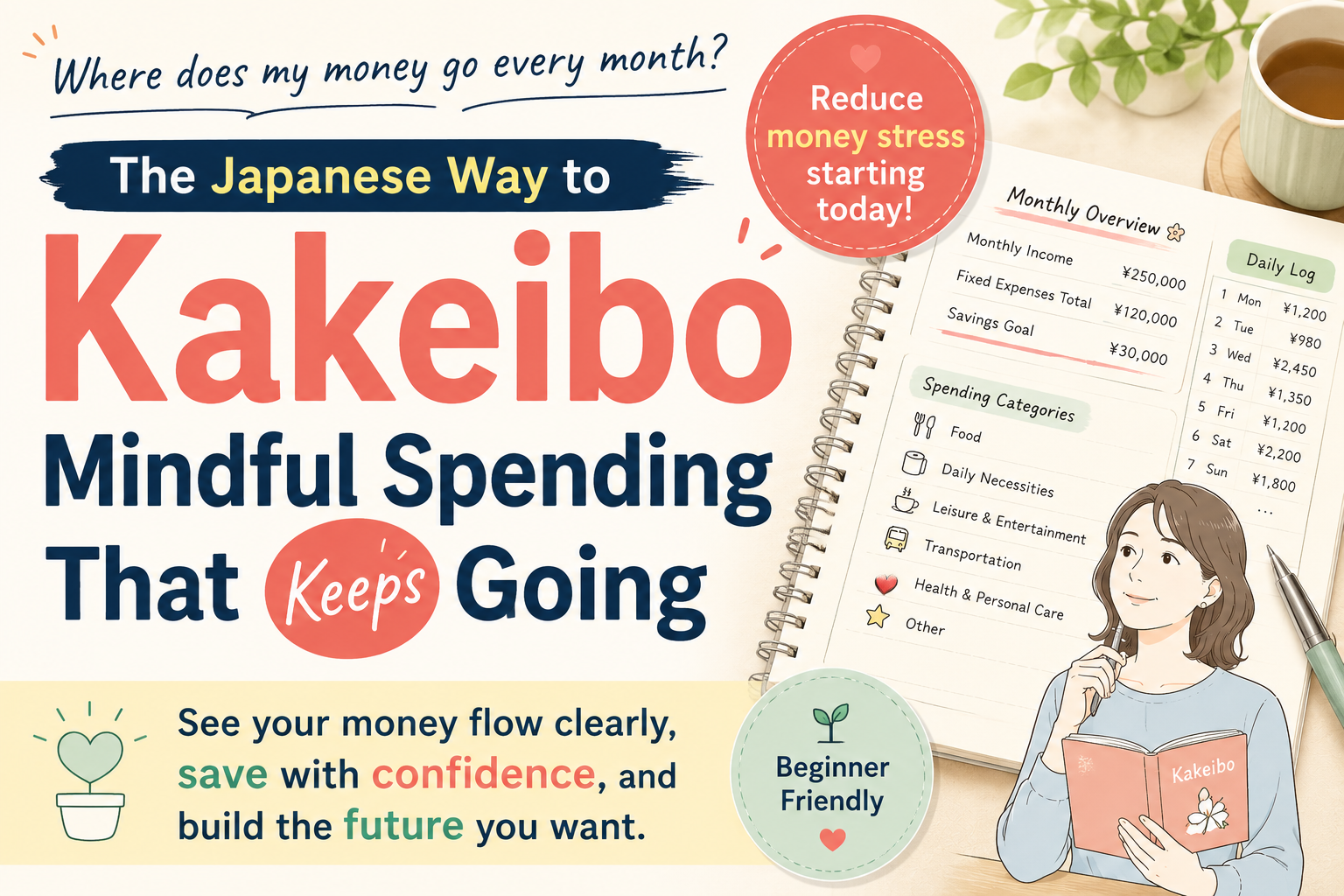
Have you ever started a household budget only to give up after a few days? You may even hesitate to try again because previous attempts did not last.
People often say that keeping a household budget increases savings, yet many abandon the practice. The reason is not simply laziness or lack of time. Deeper psychological factors are often involved.
You may be forcing yourself to use a method that does not suit you or demanding a level of accuracy that makes failure almost inevitable. This article examines why household budgets are difficult to maintain, compares management methods, and explains how to turn the practice into a habit.
The goal is not perfect recording but sustainable management.
- Three Psychological Reasons Household Budgets Do Not Last
- A Thorough Comparison of Handwriting, Apps, and Excel
- Four Points for Choosing a Household Budget You Can Continue
- Let Go of Perfection: Practical Ways to Continue
- How to Use a Household Budget for More Than Recording
- Tools and Templates You Can Use Today
- Final Principles for Making a Household Budget a Habit
Three Psychological Reasons Household Budgets Do Not Last
People often blame weak willpower, but clear psychological mechanisms are usually at work.
The first is losing motivation after missing an entry. At the beginning, people try to record every expense in detail. Then one busy day is missed, or several purchases are combined and the exact date is forgotten. The thought that the record is already ruined can destroy motivation. When perfect recording is treated as the definition of success, one omission feels like total failure.
The second is failure caused by perfectionism. People may impose rules such as classifying every purchase precisely or entering data every day without exception. Those rules collapse during travel, business trips, illness, or other changes in routine. Paradoxically, the desire for perfection creates conditions in which continuation becomes harder.
The third is a mismatch between lifestyle and management method. A person with a long commute may find nightly Excel entry unrealistic. Someone uncomfortable with smartphones may find an app unnecessarily stressful. The best method is not the one most widely recommended, but the one that fits naturally into daily life.
A Thorough Comparison of Handwriting, Apps, and Excel
Household-budget management can be divided into three main approaches, each with different strengths.
Handwritten management helps spending remain in memory because the act of writing is active and deliberate. It requires no digital skill and can be customized freely. Its disadvantages are the time required for entry and calculation, limited analysis, and the physical risk of losing the notebook. It suits people who enjoy writing, prefer a slower routine, and need only simple expense tracking.
App-based management offers speed and convenience. Entries can be made in seconds, totals and category comparisons are calculated automatically, reminders can support habit formation, and cloud storage lowers the risk of physical loss. The disadvantages are initial setup, possible difficulty for people unfamiliar with smartphones, and changes caused by app updates. It suits regular smartphone users and people who want detailed automatic analysis.
Excel management offers high flexibility and powerful formulas. Users can design exactly the format they want and manage large amounts of historical data. Its disadvantages are the need to open a computer, a higher level of digital skill, setup time, and limited convenience outside the home. It suits people comfortable with computers who enjoy building their own system.
No method is universally superior. The correct choice depends on your daily rhythm and the psychological burden each method creates.
Four Points for Choosing a Household Budget You Can Continue
First, minimize the time cost. A method that takes more than 30 minutes a day will not last. Aim for three to five minutes. Use broad categories for handwriting, a simple input screen for apps, and a ready-made template for Excel.
Second, avoid complicated rules. Excessive category detail forces a decision every time you enter a purchase. Five to seven broad categories, such as food, household goods, transportation, and entertainment, are usually enough.
Third, allow flexibility in update frequency. Do not require daily entry. A method that supports entry every two or three days is often more realistic. Waiting too long creates memory problems, but a short delay is acceptable.
Fourth, consider customization. Needs change over time. Handwriting and Excel allow extensive changes, while apps offer a range of different products. Greater freedom often brings greater setup complexity, so balance flexibility with simplicity.
Let Go of Perfection: Practical Ways to Continue
Prioritize flexible recording. Missing a day does not destroy the value of the budget. The purpose is to understand the monthly total, not to produce a perfect diary.
Decide in advance how to handle missing days. You might leave the day blank, add the amount to a nearby date, or use a reasonable estimate. A predetermined rule prevents hesitation.
Adjust the recording cycle to your life. During busy periods, enter once a week. During calmer periods, record daily. Household-budget rules should change with your circumstances rather than remain rigid.
Accepting omissions, allowing weekly entry, and adjusting by season can dramatically extend the period for which a budget is maintained.
How to Use a Household Budget for More Than Recording
The budget becomes valuable only when the records lead to decisions.
Set aside about 30 minutes at the end of each month for a review. Look for discoveries such as food spending being higher than expected or transportation costs rising. The purpose is to understand the whole picture and identify one or two improvements.
Build in a regular budget revision. If food spending was 50,000 yen, do not necessarily demand an immediate reduction to 40,000 yen. A target of 45,000 yen may be more realistic. Review goals once a month rather than changing them constantly.
Make goals specific and measurable. “Reduce food spending” is weaker than “cook at home four days a week and limit weekly food spending to 12,000 yen.” Ideally, transfer any savings directly to a savings account so the relationship between lower spending and higher savings becomes visible.
The useful cycle is recording, review, improvement, action, and result. Many people stop at recording, but the real benefit begins after action.
Tools and Templates You Can Use Today
Money Forward ME links bank accounts and credit cards and records many transactions automatically. It is suitable for people who want to minimize entry time or manage several cards. Basic household management can be started on the free plan.
Zaim places more emphasis on manual entry and offers clear visual graphs for monthly review. It suits people who want to remain actively involved in recording.
Free Excel templates can be downloaded from Microsoft and other template sites. They are suitable for people comfortable with computers who want to customize the format.
Printable PDF templates are available through sites such as Pinterest and Canva. They suit people who value the act of handwriting.
The most important criterion is whether you can begin today.
Starting with a 70-percent-suitable template is more useful than spending hours searching for a perfect one.
Experience will reveal which method truly fits you.
Begin with a free app if that is easiest. If the interface does not suit you, switch to Excel or handwriting. The critical step is trying a method rather than continuing to prepare.
Final Principles for Making a Household Budget a Habit
The two greatest causes of failure are demanding perfection and forcing yourself to use an unsuitable method.
Choose according to your actual behavior: an app if you live on your smartphone, Excel if you work mainly on a computer, or handwriting if simplicity matters most.
Remember that recording is not the final goal. Review the month, revise the budget, and turn discoveries into action.
Flexible entries, simple rules, and realistic update frequency provide the foundation for habit formation.
Do not wait for perfect preparation. Start today with a workable template.
If it does not fit after a week, change the method. Trial and adjustment are how you find a sustainable system.
A household budget is a personal tool that should follow your life, not a public definition of the correct method.
Let go of perfection, remain flexible, and continue without unreasonable pressure. That is the path most likely to produce meaningful savings over time.

コメント